
(Left) Filip Ševčík, Communications Intern at EMMA/the Future Media Lab..
In the most recent edition of our bi-weekly news roundup, Filip Ševčík shares the news that caught his eye in the past two weeks. The news round-up is a way for the Future Media Lab. team and members of the Future Media Lab. network to share articles about innovations and developments in the media sector, including references to relevant media policy debates.
Here are Filip’s choices for this week:
Adblocking
1) Despite the unsuccessful lawsuit against Adblock Plus, Axel-Springer continues its crusade against adblocking and takes Blocker, another company providing adblock services, to German court. Currently, Blocker allows users to hide ads from the website of Axel-Springer’s subsidiary, WELTN24. TechCrunch speculates that the final ruling on 10 December will be against the German publisher, since it can prevent adblocking users from accessing the content on its website, as it did in case of bild.de. However, this option will decrease the number of users and is among the 3 strategies that Johnny Ryan, Head of Ecosystem at PageFair, considers ineffective to fight adblocking. At the same time he points out that there is no universal strategy to pursue, because the levels of adblocking and unrealized revenues differ with each publisher.
2) Tim Gentry, Global Revenue Director at The Guardian, believes that better customized ad experiences and more control for users might be the answer to adblocking. In order to achieve it, he calls for higher collaboration among publishers and a unified approach towards adblocking. Similar intentions are being voiced by telecommunication providers O2 or British EE, which are currently deciding whether to introduce tools that allow customers to control the volume and intensity of mobile advertising on their devices.
Native Ads
3) However, adblocking isn’t the only thing calling for collective action or standardization. With the growing use of native advertising, users encounter labels such as “sponsored by”, “brought to you by”, “supported by” and many others. Anna Watkins, head of The Guardian’s native advertising arm the Guardian Lab is concerned that it might not be clear enough for users, because the meanings of labels vary with each publisher. This not only harms the transparency of publishers, but also lowers consumers’ trust in their content.
Media Literacy
4) A recent report from Ofcom, UK communication regulator found that one-third of UK’s digital natives aged 12-15 have problems identifying ads in Google search and nearly half did not know that YouTube is sponsored by ads. These results nicely illustrate that digital natives often lack a basic understanding of how the internet works and highlight the need for media education at schools.
Audience Engagement
*** Note: Audience engagement is the topic of the upcoming Future Media Lab. conference on 26 January 2016 in Brussels. Click here for more info! ***
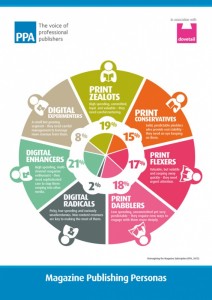
5) After PPA published its research that identifies the 7 personas of today’s magazine buyers, Jim Bilton, the author of the report and Managing Director of Wessenden Marketing, commented that the “average magazine buyer no longer exists” and highlighted how important knowledge about your audience is for media companies in order to determine the right direction of a magazine.
6) Getting content to the right audiences – and expanding the audience base - became the core goal of the audience engagement strategy and audience-first newsroom at the Financial Times. For Renée Kaplan, Head of Audience Engagement at the Financial Times, community building on social media, crowdsourcing of information and interacting with audiences are essential for the news creation process.
Business Models
7) Can dollar a day subscription be a viable business model for digitally delivered local news? With 65,000 digital-only subscribers and 56% of its overall revenue coming from readers, Peter Doucette, Boston Globe’s Vice President for Consumer Sales and Marketing, believes it is. Ken Doctor, news industry analyst and author of Newsonomics, is more cautious and notes that if The Globe manages to get 200,000 digital-only subscriptions while keeping the overall revenue coming from readers between 50% and 60%, then it can be considered a successful, sustainable business model. He also expects that in the future, reader revenue-centric models for publishers will be the way to go.
8) The Knight Foundation has a new open source project that will provide an alternative mechanism to support authors and publishers. “Tipsy” works by keeping track of users’ browsing habits within the browser, and it converts time spent on any given website into a small donation while the conversion rate and actual donation remain in control of the user. This tool might be particularly relevant after the rise in adblocking, since it offers users an easy way to support publishers while not deteriorating their own user experience.
Read something that you think needs to be shared? Please send us an e-mail: [email protected]